Somebody Has to Own AI at Your School. Right Now, Nobody Does.
Why AI keeps landing on the desk of whoever's already carrying the most — and what to do about it before it becomes a problem.
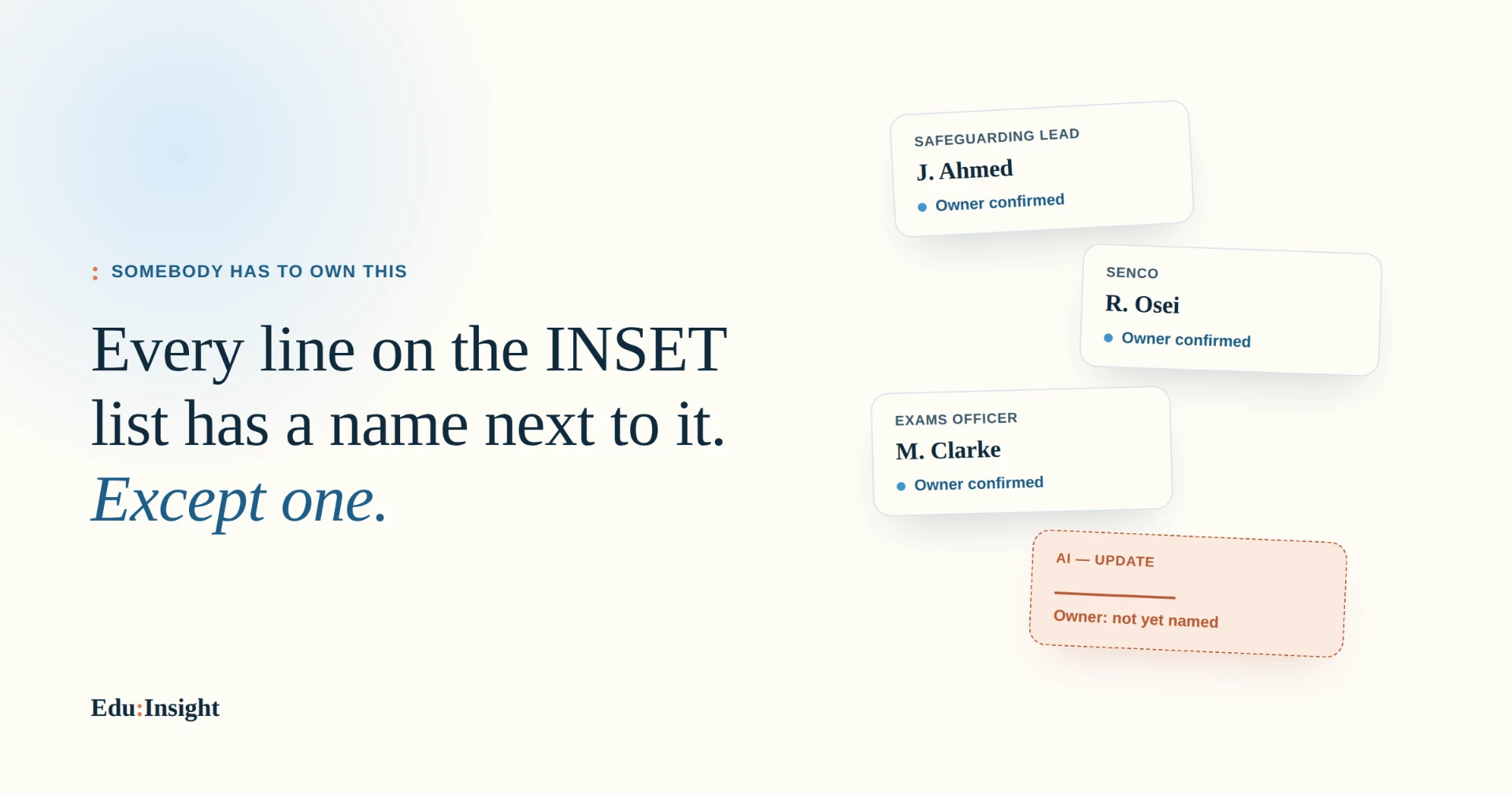
Right, so — summer's over, the shine's already off the "I'm going to be so organised this year" plan, and the INSET list has landed in everyone's inbox looking exactly like it always does.
Timetables. Fire drill dates. Safeguarding refresher (again — yes, we know, sign the register). New starters induction.
And then, usually somewhere near the bottom, in the font that means "we ran out of time to think about this properly": AI — update.
If you're the one reading that line and quietly feeling your stomach drop a bit, because you have a suspicion it's about to become your problem — fair. You're not imagining it.
Something about AI has a habit of landing on the desk of whoever's already carrying the most, precisely because nobody's decided whose job it actually is.
Which is a strange place for it to sit, when you think about it for more than four seconds.
Nobody would ever let "safeguarding" sit on a list with no name attached to it. Nobody's running SEND provision on a rota of whoever's free that week.
But AI? Currently just sort of... floating.
Everyone's using it, nobody's quite in charge of it, and somewhere along the line the plan became "hope it sorts itself out."
It won't.
And if you're the person this keeps quietly landing near, you already know that better than anyone writing advice about it.
We wrote a while back about who actually carries the can when an AI tool gets something wrong — short version: policy owns the upstream stuff, judgement owns the moment, and accountability follows whichever side actually broke down.
That post assumed a policy existed, being looked after by an actual human.
This one's for that human.
Or, more accurately, for whoever's about to become that human without being asked properly.
The job that's pretending to be a task
Here's the bit that gets missed, usually by whoever's handing this down rather than whoever's picking it up.
"Sort out AI" sounds like a task — something you knock off in an afternoon, file under done, get back to your actual job.
It is not that.
It's a job.
An ongoing, mildly relentless one, and if it's landed on you as an add-on to everything else you're already doing, you have every right to feel a bit ambushed by that.
Because look at what it actually involves.
- Knowing which tools are genuinely approved, and for what — not "AI's fine for feedback" as a vibe, but specific, bounded uses you could repeat back to a colleague in the corridor without hedging.
- Keeping a running, current sense of how each of those tools tends to go wrong, because every single one of them is confidently wrong in its own special way, like a colleague who's always sure and only sometimes right.
- Making sure training actually reflects that, not just "use AI responsibly," which is the educational equivalent of "drive safely" — true, and completely useless on its own.
- And, on top of all that, actually keeping half an eye on what the OECD, the DfE, and whoever else keeps issuing guidance are publishing this month, because education is one of the few corners of this whole AI conversation where the official advice changes almost as fast as the tools it's meant to be keeping up with.
None of it — tools, guidance, staff habits — sits still long enough for anyone to relax, let alone tick it off a list once and move on.
Try fitting that into a single Twilight INSET slot between the fire extinguisher training and someone's leaving cake.
It doesn't fit.
It was never going to fit.
If you've been quietly expected to make it fit anyway, that's not a personal failing — that's a job description problem, and it's not yours to solve by working harder.
A policy on the shared drive isn't the finish line
Worth saying plainly, because it's an easy trap for an already-stretched admin team to fall into with the best of intentions: having a policy is not the same as having this handled.
A lot of schools got as far as a document last year, felt the genuine relief of having produced Something, and quietly stopped there.
Understandable — that document probably ate an evening or three that should've gone to something else entirely.
But a policy written once in February and left to season gently on the shared drive since then isn't oversight.
It's a photograph of what was true six months ago, wearing an oversight costume.
There's a second, sneakier version of the same trap, and it usually comes from a genuinely well-meaning place: writing "staff should report any AI-related issues to [role]" into the policy and treating that line as the job, finished.
If that's where things currently sit at your school, it's worth naming honestly what that actually does — it quietly hands the legwork straight back to already-stretched staff, on top of everything else on their plate, and calls it a monitoring system.
It isn't one.
It's hoping someone notices and says something, which is a nice hope, not a process.
None of that means anyone's doing a bad job.
It usually means everyone involved is already maxed out, and this got the amount of attention that was actually available, which was not much.
That's the honest starting point, not a criticism.
Not an IT job. Definitely not an IT job.
If this has landed near you because you're "good with computers," we're sorry, and also: wrong reason.
This isn't primarily a technical problem, and being the one people call when the projector won't connect doesn't actually prepare you for it.
Because the genuinely hard questions here aren't technical at all.
- Does the way a tool writes feedback quietly undermine what the school's trying to teach students about their own thinking?
- Does the marking approach still make sense once half the department's using AI-assisted feedback and the other half's avoiding it out of quiet suspicion?
- Does a Year 8 student still know what "this is my own work" is supposed to mean?
Nobody solves that by being excellent at IT.
It takes someone who understands how the school actually runs day to day — the timetable, the staffroom mood, the safeguarding obligations, what survives an actual Monday morning versus what just sounds good on paper.
If that's you, you already have more of what this job needs than any spreadsheet of technical skills would suggest.
That's worth hearing, especially if nobody's said it to you directly.
Why saying yes to this is genuinely hard — and why that's not on you
Here's the part most advice about this skips straight past: even once a school agrees someone should own it, actually finding a willing someone is hard.
And it's not because staff don't care.
It's because everyone in the building has already correctly clocked how big this is, and nobody's rushing to raise a hand for "big, vague, ongoing, and not currently in my job description, or my pay, or my timetable."
If you're the one being asked, here's what you're actually being asked to take on:
- Owning something that reshapes itself every term.
- Being the person who has to say "hang on, who approved this" when a new tool turns up unannounced.
- Doing the genuinely unglamorous, recurring work of keeping a document alive instead of writing it once and quietly letting it fossilise.
That's not a box you tick.
It's closer to carrying a whole-school priority than running a lunchtime club — and right now it tends to come with roughly the recognition of a lunchtime club.
If you're on the admin team, that's a big ask stacked on an already full plate.
If you're a classroom teacher, it's real hours pulled away from planning and marking, for a responsibility the person signing it off doesn't always fully understand yet — which makes it a genuinely awkward thing to be asked, and just as awkward to push back on.
None of that means you shouldn't do it.
It does mean you're allowed to feel the size of it, and to ask for the time and recognition that should come attached to it, rather than absorbing it quietly because saying no feels like letting the school down.
Naming that difficulty honestly feels like the useful bit, actually — more useful than the usual "just assign someone" line, which is a bit like telling someone treading water to try swimming better.
A month away doesn't mean you're behind
And perhaps that's why we needed a bit of time away ourselves.
We've been away for one summer month.
And, if we're honest, we've spent some of that time wondering whether we're behind.
Whether we should have been doing more.
Whether everyone else has somehow moved further ahead while we've been taking a breath.
Those worries have a habit of following you around, even when you're technically on a break.
You know the feeling: you're supposed to be switching off, but somewhere in the back of your mind there's a quiet running list of things you haven't done yet.
The work waiting for you.
The ideas you haven't finished.
The things you said you'd get around to.
The nagging suspicion that taking a break is somehow the same thing as falling behind.
But we're starting to think about it differently.
Maybe taking a proper break isn't falling behind at all.
Maybe sometimes the most productive thing you can do is step away for long enough to recharge, clear some space in your head, and come back able to think properly again.
Taking a break to recharge is probably one of the best investments you can make in yourself.
Not because the work disappears.
It doesn't.
Not because AI politely pauses while everyone goes away for August.
It definitely doesn't.
But because good work requires people who have enough space to think, question, notice what's changing, and make decent decisions.
You can't keep pouring from an empty cup and call it strategy.
So, we've had our month.
We've worried about whether we were behind.
We've probably worried more than was necessary.
And now we're back.
Back to work.
Back to the questions.
Back to the slightly uncomfortable conversations about what AI actually means for schools, staff and students.
And, honestly, we're glad to be back.
We're back — and this is still the point
AI hasn't stood still while everyone was away for the summer.
The questions are still there.
The policies still need attention.
Staff still need somewhere to have honest conversations.
Leadership teams still need to work out what they actually believe, rather than simply adding "AI" to the next meeting agenda and hoping somebody else will explain it.
And someone still has to make sense of what happens next.
We see it.
That's really the whole point of this post.
We're Edu:Insight, and we spend most of our time talking to exactly the people this lands on — the deputy head who's inherited it alongside four other briefs, the head of department who got asked "could you just look into this," the teacher who said yes because nobody else would.
We've stood in that spot ourselves, so none of this is theoretical to us: we know what it's like to be handed something enormous and vague and told to make it work by September.
We're not here to tell you to just find more hours in the week, because there aren't any.
What we can do is take some of the actual weight off — an AI Readiness Review so you're not guessing at how much ground is genuinely covered, a policy and tool-tracking structure built for you rather than one more thing you have to draft from scratch on a Sunday, or ongoing support sitting alongside whoever's carrying this, so it's not one person's problem to hold alone.
A free tool for the conversation you need to have
We've just uploaded a new free tool to our website: the Staff & Leadership Conversation Decision Tool.
It's a practical decision tool designed to help leaders structure honest, productive conversations about AI with staff and leadership.
Because sometimes the hardest part isn't knowing that you need to talk about AI.
It's knowing how to start the conversation.
What do you ask?
How do you surface the concerns people aren't saying out loud?
How do you stop a useful discussion becoming either an argument about AI in general or a room full of polite nodding?
And how do you move from "we probably need to think about this" to an actual, useful next step?
The tool gives you:
- A clear structure for difficult AI conversations with staff and leadership.
- Prompts to surface concerns early — before they become conflicts.
- A ready-to-use format for your next leadership or staff meeting.
You don't need to have all the answers before you start.
In fact, you probably shouldn't.
The important thing is creating enough space for the right questions to be asked, the concerns to be heard, and the decisions to be made properly.
So if AI is sitting somewhere on your school's agenda this term — perhaps near the bottom of the INSET list, perhaps quietly making its way towards your desk — don't wait until something goes wrong before you start the conversation.
Check out our new free Staff & Leadership Conversation Decision Tool and use it in your next leadership or staff meeting.
Because AI ownership shouldn't mean one person quietly carrying the whole thing.
And sometimes the best place to start is simply getting the right people around the table.