Confidence is not correctness: AI literacy and the case for deep thinking in schools
AI literacy is a thinking skill, not a tool skill. Why schools need to protect deep work, and how a simple checking protocol makes student thinking visible.
Our students already use AI. The question for schools is no longer whether they use it, but how well.
AI answers arrive fluent, fast and confident, and confidence is easy to mistake for correctness. For a generation still learning how to think, that is the real risk.
A moment from my classroom
Last term a Year 11 student showed me an AI explanation of why graphite is soft and diamond is hard. It was clear and confident, and it said graphite is soft because its covalent bonds are weak.
That is a very common misconception. The bonds within each layer of graphite are strong. Graphite is soft because the layers are held together only by weak forces, so they slide over one another. The student had copied the explanation into her revision notes without a second thought.
When I asked how she knew it was right, she paused. "Because it sounded right."
That pause is exactly what I want to teach. It is the moment where a student stops being a consumer of answers and starts being a thinker.
AI literacy is a thinking skill, not a tool skill
Tools change every term. Knowing which button to press has a short shelf life. Knowing how to question an answer does not.
In my science classroom, the most useful AI skill is not prompting. It is judgement. Should I believe this? How would I know? What would I expect to see if it were true, and what would change my mind?
These questions work on any tool, in any subject, at any point in a student's life. A school that teaches them is preparing students for tools that do not exist yet.
Where High Performance Learning fits
If your school uses a High Performance Learning approach, you will recognise that working well with AI draws on skills we already want to develop: analysing information, linking ideas across contexts, and metacognition, which is thinking about your own thinking. It also draws on the values and attitudes we hope students build, such as curiosity and resilience.
AI does not replace any of these. It tests them. A student with strong analytical habits will interrogate an AI answer. A student without them will accept it. The tool simply makes the gap visible.
The quiet risk is dependence
A recent commentary on education and AI makes a point I agree with: the danger is not that students use AI, but that they come to rely on it.
Struggle is part of learning. Researchers call this "desirable difficulty": effort that slows us down now and strengthens understanding later. If AI removes every difficulty, students gain speed and lose depth. The work gets finished, but the learning that the work was meant to produce does not happen.
Deep work was never easy, and AI makes it harder
Cal Newport's book Deep Work describes the ability to concentrate without distraction on a cognitively demanding task. He argues that this ability is becoming both rarer and more valuable. He contrasts it with shallow work: the quick, logistical, easily replicated tasks that fill a day without moving anything important forward.
Deep work was never easy. We fight the pull towards distraction every day, because the shallow alternative is always one tap away. Anyone who has tried to write a difficult report with a phone on the desk knows this.
Now put AI beside that. It offers the thing our brains like best: everything done in a minute. A summary, an essay plan, a solved problem, all instant. Compared with the slow effort of working something out, the shortcut wins nearly every time. That is true for adults as much as for teenagers.
To be clear, this is my application of Newport's idea. He wrote the book before tools like these existed, so he is not making this claim about AI. But the link seems clear to me. Focus is like a muscle, and every time we skip the struggle, it gets a little weaker. If students never practise staying with a hard problem, they will not be able to when it matters: in an exam hall, in a university seminar, or in a career where the problems have no answer key.
There is a second, quieter cost. Deep work is where students build the mental models that make later learning easier. The student who has wrestled with why graphite and diamond behave so differently now has a structure to hang new ideas on, such as bonding, lattices and properties of materials. The student who was handed a fluent summary has a sentence to repeat. The two look identical on a page of notes. They are very different in an exam.
So the job of a school is not to ban the shortcut. It is to protect time for deep thinking, and to teach students to use AI after they have wrestled with the problem, not instead of it.
Struggle first, AI second
A simple rule of sequence can do a lot of work:
- Attempt the problem first, without AI, for a set period of time.
- Write down what you think and where you are stuck.
- Then use AI, and treat what it says as something to test, not something to copy.
This keeps the productive struggle that builds understanding, and it gives the AI a better job: a challenger and a source of alternatives, not a replacement for the thinking.
Make the checking visible
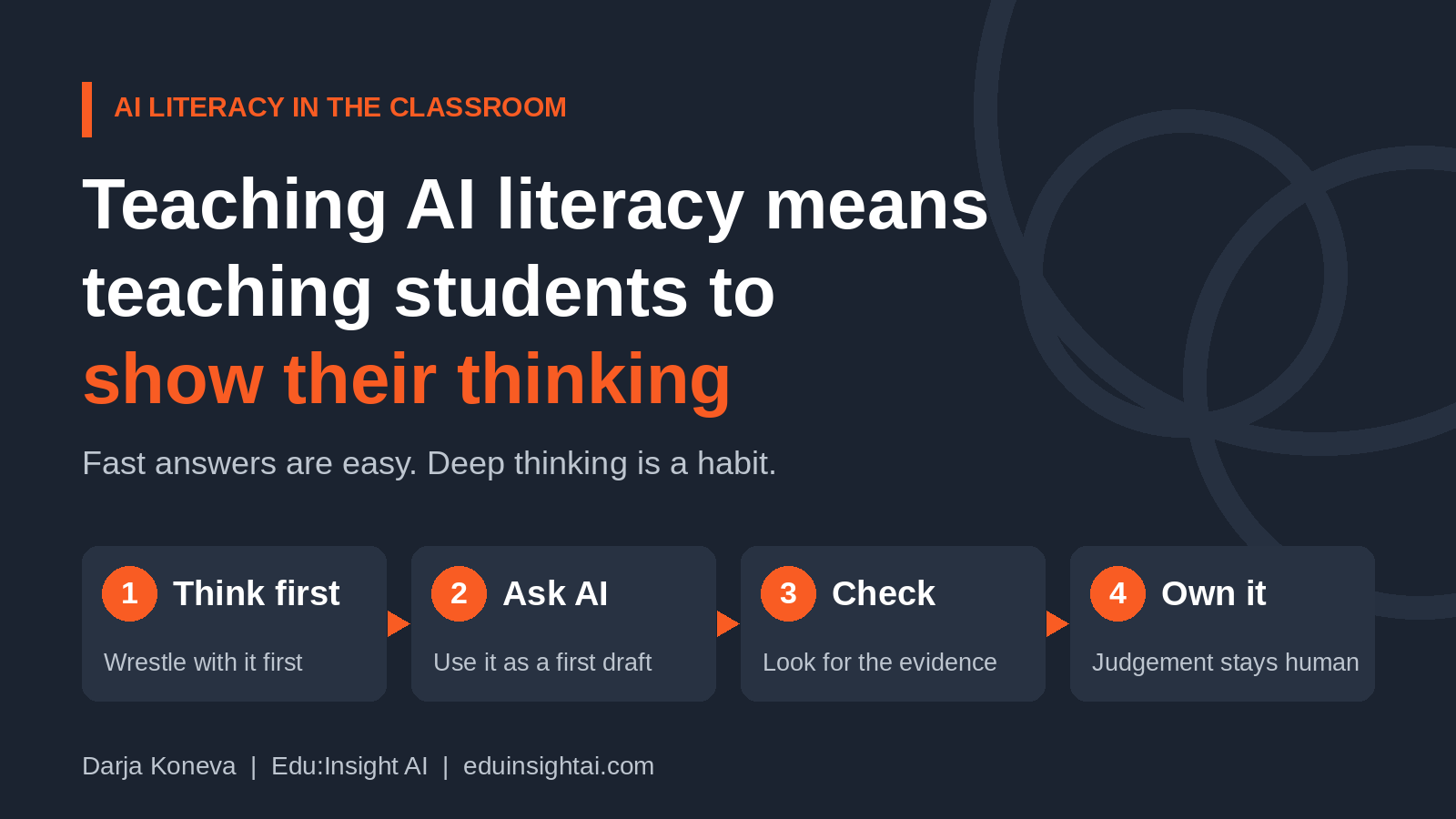
One idea I find powerful is the checking protocol: a short written record that a student keeps whenever they use AI. It captures four things:
- What I asked.
- What I tested.
- What evidence I found.
- What I concluded.
In the graphite example, the record would show a question (why is graphite soft?), a test (compare the bonding and structure of both forms), evidence (strong bonds inside layers, weak forces between them) and a conclusion (the AI was wrong: the layers slide, the bonds are not weak).
It matters for four reasons:
- It makes thinking visible, which is metacognition in practice.
- It lets teachers assess the process and not only the final answer.
- It builds a habit of looking for evidence before giving trust.
- It makes AI use open and honest, rather than hidden.
A student who can show how they checked an answer has learned something that lasts longer than the answer itself. Checking is slow on purpose. It is a small piece of deep work in a world built for speed.
What this changes for teachers
- Treat AI output as a first draft, never a final answer.
- Check AI answers out loud in front of students, including when the answer is right. Students need to see that verification is a habit, not a reaction to suspicion.
- Reward the reasoning, and let students see that questioning a confident answer is a strength.
- Design tasks where the process counts, so that a polished final answer is not enough on its own.
What this changes for school leaders
- Protect time. If deep thinking is not on the timetable, the shortcut will fill the space. Look for places where students can work without devices for sustained, demanding stretches.
- Make expectations explicit. Students and staff both need to know when AI is welcome, when it is not, and why.
- Assess process as well as product. A checking protocol gives you something to assess that AI cannot simply produce.
- Build staff confidence. Teachers cannot model good judgement about tools they have not had the chance to question themselves. Time to experiment, get things wrong and compare notes is part of readiness.
AI will keep changing, and it will keep getting faster. The habit of slowing down to ask "how do I know?" is the part we must protect.
How are you protecting deep thinking in your school or classroom?
If your leadership team is working out its approach to AI, Edu:Insight AI helps schools build readiness that starts with thinking, not tools. Grab the AI Policy Checklist or book a free 30 minute discovery call.
References
- Newport, C. (2016). Deep Work: Rules for Focused Success in a Distracted World. Grand Central Publishing.
- Khanna, S. and Chaudhari, C. (2026). "The Last Generation to Learn Without AI." Countercurrents, 24 June 2026.